
China, 3rd Nov 2026 – A thinner thermal interface looks like a straightforward way to reduce resistance between a processor and its cooling hardware. For the engineer developing the material, that goal quickly becomes a formulation problem. The filler has to fit the gap, and the mixture still has to flow into place. Choosing a finer diamond powder can help with the first requirement while making the second harder.
Suppose a TIM formulation contains coarse particles that keep an assembly from reaching its intended bond-line thickness. Moving to a finer distribution seems reasonable. At the same filler volume, however, smaller particles expose more surface for the matrix to wet. Viscosity may rise, and a mixture that worked through the dispensing equipment may become difficult to process. The thinner layer now depends on solving a different problem.
This is where Diamond Powder belongs in thermal management: as a filler dispersed in a matrix for thermal interface materials, thermally conductive adhesives, gap fillers, encapsulants, or potting compounds. It is a formulation ingredient, distinct from a CVD diamond sheet attached near a chip. The finished material gets its behavior from the combination of filler and matrix, including how they are mixed and assembled.
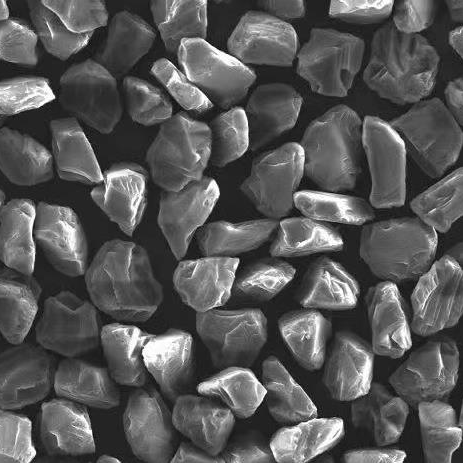
Thermally conductive diamond powder for evaluation as a filler in thermal management formulations.
A smaller particle changes the whole mixture
The nominal particle size tells only part of the story. A small population of oversized particles can hold a thin interface open. Agglomerates can interfere with dispensing even when the individual particles are fine enough. Looking at the full particle-size distribution and the dispersion after mixing helps explain behavior that an average size can hide.
Heat also has to cross the boundaries between diamond and the surrounding matrix. Diamond’s intrinsic thermal conductivity describes the solid material; the formulation contains polymer between particles and resistance at their interfaces. Changing particle size changes that network. A finer powder can therefore improve the achievable bond line without necessarily improving the mixture’s bulk thermal conductivity. Those are separate effects, and either can influence the assembled interface.
Adding more filler introduces another tradeoff. Higher loading can improve conductive pathways, yet it also leaves less matrix available to wet the particles and carry them through processing. Poor flow or trapped air can undermine the expected benefit. A formulation engineer has to find a workable balance between thermal transport and the consistency needed on the production line.
A blend of sizes offers room to adjust that balance. Smaller particles can occupy spaces between larger ones, changing packing behavior and potentially allowing more solids. Whether that helps depends on the proportions and surface condition as well as the mixing process. An added fine fraction may instead raise viscosity. Packing is useful because of what it enables in the formulation, rather than as an isolated target.
The application determines how much processing freedom is available. A thin TIM over a processor faces a different gap and assembly pressure from a thick gap filler. A potting compound has to flow around components inside a cavity. Carrying the same powder choice across these applications can overlook the feature that made it useful in the original recipe.
Surface treatment deserves a place in that discussion. A change intended to improve wetting can also affect adhesion or electrical behavior, so it needs evaluation in the selected matrix.
Find out which change produced the result
For the thin-interface project, the first comparison can hold the matrix and filler volume constant while changing the particle-size distribution. Keeping preparation and cure conditions consistent makes the result easier to interpret. If the finer material then needs a lower loading to dispense, that becomes a second formulation comparison. Report loading consistently as a weight or volume fraction so the difference remains clear.
Measure thermal behavior at comparable thickness, pressure, and temperature. Thermal impedance includes the layer and its contacts; measurements at several thicknesses can help distinguish bulk behavior from contact resistance. Pair those results with the bond-line thickness actually achieved during assembly. A value from a thick specimen alone leaves the original thin-gap question unresolved.
Electrical insulation and durability belong in the finished-material evaluation. The matrix and any other additives affect dielectric behavior, while aging can change the interface after assembly. Pump-out may matter for a compliant TIM; adhesion or cracking may be more relevant to a cured adhesive. These checks follow the application rather than the powder description.
Engineers reviewing Yorsuma’s diamond material range for a formulation trial can start with the matrix and the gap they are trying to fill. Explaining whether the current limit is dispensing, bond-line thickness, or measured thermal resistance gives the material discussion a useful direction. The better powder is the one that helps the formulation work in that assembly, with the result established through formulation trials and representative hardware testing.
Media Contact
Organization: SHENZHEN YORSUMA TECHNOLOGY CO.,LTD
Contact Person: Wang Hongyuan
Website: https://www.yorsuma.com/
Email: Send Email
Contact Number: +8615516071929
Address: Room 703, Tower C, Phase II, Excellence Baozhong Times Plaza, Xinan Street, Bao’an District, Shenzhen City, Guangdong Province, China (Shenzhen Office).
Country: China
Release id: 50261
View source version on King Newswire:
Diamond Powder Particle Size Tradeoffs in Thermal Interface Materials

Disclaimer: The views, suggestions, and opinions expressed here are the sole responsibility of the experts. No Brite Research journalist was involved in the writing and production of this article.